Flies & Fly Tying
Best Flies for Trout in Winter
Winter trout fishing is a nymph game played in slow deep water with small flies. Three patterns do most of the work.
The best flies for trout in winter are small dark nymphs and midge patterns fished deep and slow: a zebra midge, a small pheasant tail and a tiny beadhead in sizes 16 to 22. If you want one purchase that covers it, the [Orvis Essential Trout Nymph Assortment](#orvis-essential-trout-nymph-assortment) is the right box, because winter is a subsurface season almost from start to finish.
The thing that surprises people coming from summer fishing is the direction of the change: winter flies get smaller, not bigger. The intuition is that a cold fish wants a big meal. In fact a cold trout's metabolism has slowed to the point where it will not chase anything, and the only insects still hatching in numbers are midges — which are tiny. Matching that means fishing flies that look alarmingly small the first time you tie one on.
The short list
| # | Pick | Best for | Score | Price |
|---|---|---|---|---|
| 1 | Orvis Essential Trout Nymph AssortmentNymphs onlyBest Overall | Winter is a subsurface season, and this is the subsurface set | 7.8 | Check price on Amazon |
| 2 | Orvis Essential Trout Fly SelectionPre-packaged assortmentBest Value | A curated box that covers winter and the rest of the year | 7.8 | Check price on Amazon |
| 3 | RIO Powerflex TippetCo-polymer, PTFE coatedBest for Trout | 6X tippet, which is what small winter flies need | 8.2 | Check price on Amazon |
| 4 | Umpqua UPG LT Standard Foam Fly BoxTPE fly sheets · slimBest Upgrade Pick | A slim box, because a winter selection is a small one | 8.1 | Check price on Amazon |
1. Best Overall
Orvis Essential Trout Nymph Assortment
The assortment that catches the most fish, if you are willing to fish a fly you cannot see.
| Spec | Value |
|---|---|
| Type | Nymph-only pre-packaged assortment |
| Packaging | Pre-packaged set |
Trout take the large majority of their food underwater, as nymphs drifting in the current. That means a box of nymphs will out-fish a box of dry flies on most days on most rivers, and the Essential Trout Nymph Assortment is Orvis's pre-packed version of that box.
The trade is not price, it is engagement. Fishing a dry fly means watching a fish rise and eat something you can see, and it is the reason a lot of people fly fish at all. Nymphing means watching an indicator and setting the hook on a hesitation.
Our dry-dropper rig guide is the way to have both: a visible dry fly on the surface with a nymph hanging below it. If you buy one assortment, buy the mixed Essential Trout Fly Selection. If you buy two, these are the second.
What we like
- Trout do most of their feeding below the surface, so a nymph-weighted box out-fishes a dry-weighted one most days
- Narrower selection is easier to learn than a mixed box
What you give up
- No dry flies, so you cannot fish a rising fish without buying more
- Nymphing is slightly harder to learn than fishing a dry you can see
| Criterion | Score / 10 |
|---|---|
| Pattern choice | 8 |
| Hook quality | 9 |
| Beginner value | 8 |
| Local relevance | 5 |
| Value | 8 |
| Overall | 7.8 |
2. Best Value
Orvis Essential Trout Fly Selection
The right first fly purchase if you do not have a local shop to ask — a curated set rather than a hundred random flies.
| Spec | Value |
|---|---|
| Type | Pre-packaged trout fly assortment |
| Packaging | Sized to slip into a wader pocket or sling pack |
| Related sets | Essential Trout Dries and Essential Trout Nymph assortments sold separately |
The hardest part of buying your first flies is that the question has no general answer: the right fly depends on your river, the month and what is hatching. Faced with that, most beginners buy a hundred-fly bulk assortment, and most of those flies never get fished.
A curated assortment is the better compromise. Orvis's Essential Trout Fly Selection is a pre-packaged set sized to live in a wader pocket, and Orvis also sells dries-only and nymph-only versions if you already know which style your water calls for.
The honest caveat, and we would rather say it than sell you flies: if there is a fly shop within driving distance, go in and ask. Local knowledge beats any national selection, and it costs you nothing.
What we like
- Removes the single most paralyzing decision a beginner faces, which is which flies to buy
- Covers dries and subsurface patterns rather than only one style
- Orvis hooks and tying quality are consistent, which matters because a bent hook point is invisible until you miss a fish
What you give up
- Generic across the country rather than matched to your local water
- Costs more per fly than buying a bulk assortment
| Criterion | Score / 10 |
|---|---|
| Pattern choice | 8 |
| Hook quality | 9 |
| Beginner value | 8 |
| Local relevance | 5 |
| Value | 7 |
| Overall | 7.8 |
3. Best for Trout
RIO Powerflex Tippet
The spool that makes a tapered leader last a season instead of an afternoon.
| Spec | Value |
|---|---|
| Material | Co-polymer |
| Coating | PTFE |
| Color | Light gray |
Tippet is plain level line on a spool, and its job is to be the sacrificial end of your leader. You tie a length of it to the thin end of your tapered leader, and when it gets short from fly changes you add another length instead of buying another leader.
RIO's Powerflex is a co-polymer with a PTFE coating in light gray. It is supple, which lets a small dry fly sit and drift naturally rather than being dragged by a stiff tether. Two spools — 5X and 4X — cover almost all trout fishing a beginner will do.
One thing worth knowing: nylon and co-polymer tippet ages. UV and heat weaken it, so a spool that has spent two summers on a dashboard should be thrown away rather than trusted on a good fish.
What we like
- Supple enough to let a small fly move naturally, which is most of what tippet does
- A single spool outlasts several tapered leaders, so it is the cheap half of the system
- The light gray is genuinely hard to see in moving water
What you give up
- Co-polymer floats more readily than fluorocarbon, which matters if you are fishing deep nymphs
- Degrades with UV and age — a spool that has lived on a dashboard for two summers is not trustworthy
| Criterion | Score / 10 |
|---|---|
| Suppleness | 9 |
| Knot strength | 8 |
| Visibility | 8 |
| Durability | 7 |
| Value | 9 |
| Overall | 8.2 |
4. Best Upgrade Pick
Umpqua UPG LT Standard Foam Fly Box
The box to buy once you own enough flies to lose them — light, slim, and the foam actually holds.
| Spec | Value |
|---|---|
| Fly sheets | TPE (thermoplastic elastomer), injection-molded |
| Design | Single-sided slim |
| Range | Mini, Standard and high-capacity variants |
Fly boxes matter for one unglamorous reason: a fly that works loose in your pocket is a hook in your finger and a fly you cannot find. Umpqua's UPG LT boxes use injection-molded TPE fly sheets, which are lighter than silicone and grip a hook shank firmly.
The LT Standard is a slim, single-sided box that lies flat in a pocket. There is a Mini for a pocket selection and higher-capacity versions for a full season's flies, all in the same family, so boxes stack and match.
You do not need this on day one. Every fly assortment ships in something. Buy this when you notice you are carrying three battered plastic boxes and cannot find a size 16 Parachute Adams in any of them.
What we like
- TPE sheets are lighter than silicone and grip hooks hard, so flies do not shuffle loose
- Slim single-sided design fits a shirt or wader pocket flat
- Three sizes in the same family, so a second box matches the first
What you give up
- Single-sided means less capacity per box than a double-sided design
- Costs several times what a cheap plastic compartment box does
| Criterion | Score / 10 |
|---|---|
| Foam grip | 9 |
| Capacity | 7 |
| Pocket fit | 9 |
| Durability | 8 |
| Value | 7 |
| Overall | 8.1 |
What trout eat in winter
Three things, in descending order of how often they matter. Everything else is an exception.
| Food | When | Patterns | Sizes |
|---|---|---|---|
| Midge larvae and pupae | All winter, every day | Zebra midge, black beauty, WD-40 | 18-22 |
| Overwintering mayfly nymphs | All winter, drifting in the current | Pheasant tail, small hare's ear | 16-20 |
| Midge adults | Warmest hour of a mild day | Griffith's gnat, small Adams | 18-22 |
| Eggs | Late autumn into early winter, below spawning fish | Egg patterns, small glo-bugs | 14-16 |
| Small streamers | Occasionally, on milder days | Woolly bugger, small sculpin | 8-12 |
Notice that four of the five rows are subsurface. In winter, if you are not fishing under the surface you are mostly not fishing. The exception is a mild afternoon when midges come off in rafts and fish start dimpling — a real and genuinely exciting event, but one that lasts an hour, not a day.
Where the fish are, which decides how you fish
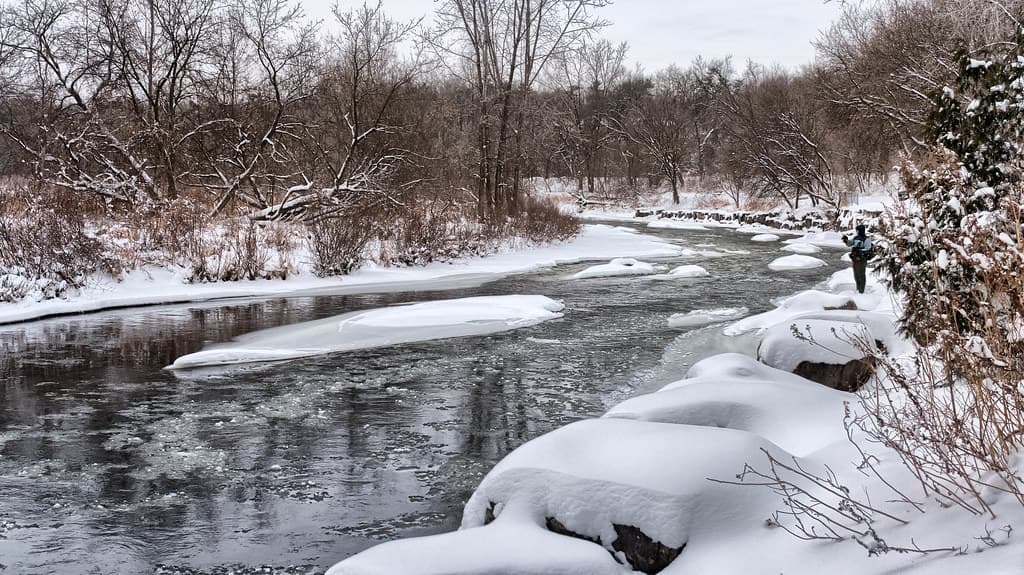
Winter changes the water you fish as much as the fly you fish. Trout move out of riffles and fast runs and stack up in the places that cost them the least energy.
- Deep slow pools. The default winter answer. Fish hold low and barely move.
- The tail of a pool, where it shallows. Often holds more fish than the head in cold water.
- Soft seams behind boulders. The same holding water as summer, but fish are tighter to it.
- Tailwaters below dams. Water released from depth is warmer than a freestone river in January, which is why tailwaters are the classic winter destination.
- Spring creeks. Groundwater holds a steady temperature all year, so the insects keep hatching.
Because the fish are deep and slow, the rig does the work. A small nymph under an indicator, with enough weight to reach the bottom third of the column, drifted at the speed of the current. Our dry dropper rig explained page covers the simpler version of this, and in winter you are usually better off replacing the dry with an indicator so the lower fly rides deeper.
The tackle changes that come with small flies
Four adjustments, none expensive, and ignoring them is why people conclude winter fishing does not work.
- Finer tippet. A size 20 fly on 4X does not drift naturally and barely fits through the eye. 5X or 6X is the winter range — our tippet size chart gives the diameters against hook sizes.
- A longer leader. More separation between the fly line and the fly, because the water is often clear and low and the fish have all winter to look at things.
- More weight, placed above the fly. Reaching the bottom third of a deep slow pool is the whole game. A tungsten bead or a small shot 10 inches above the fly does it.
- Slower everything. Longer drifts, fewer casts, less water covered. A winter day is about fishing one pool properly, not covering a mile.
If tying a size 20 onto 6X in cold weather sounds unpleasant, it is, and that is the honest cost of the season. A tippet ring on the end of your leader reduces how often you have to rebuild the whole thing with cold fingers.
What to buy, and what not to
| Buy | Roughly how many | Why |
|---|---|---|
| Zebra midges, black and red, 18-20 | 6 | The single most productive winter fly in most of the US |
| Small pheasant tails, 16-18 | 4 | Overwintering mayfly nymphs drift all season |
| Beadhead hare's ears, 16 | 4 | The generic nymph that covers what you cannot identify |
| Griffith's gnats, 18-20 | 4 | For the one hour the midges come off |
| Egg patterns, 14-16 | 2 | Late autumn and early winter only |
| 6X tippet | 1 spool | Non-negotiable with flies this small |
That is about twenty flies and one spool of tippet. It fits in a single slim box, which is the argument for the Umpqua UPG LT Standard rather than a larger one — a winter selection is small by nature. What we would not buy is a big general assortment in the hope that winter patterns are in there; most pre-packed boxes are weighted toward summer sizes. How many flies do I need makes the broader case for carrying less.
Honest expectations for a winter day
Winter fly fishing is the most technical and least productive season, and it is worth going in with that calibrated.
- Fewer fish, often bigger. The ones that eat in cold water tend to be the efficient feeders, which skews larger.
- A short window. The warmest part of the day, roughly 11am to 3pm, is when insect activity and fish activity overlap.
- Fish do not move to the fly. You have to put it within inches. That is a drift problem, not a pattern problem.
- Hands are the limiting factor. Not skill, not flies. Bring a towel, and consider fingerless gloves.
- It is the best season to learn nymphing. Nothing else is working, so you practise the one technique that catches the most fish all year.
That last point is the real reason to go. Most beginners avoid subsurface fishing because they cannot see what is happening. A winter where nymphing is the only option is the fastest way to get good at it, and the skill carries straight into spring. For the gear side of cold-weather fishing, waders by water temperature is the page that keeps you out there long enough to learn.
Questions people actually ask
What flies work best for trout in winter?
Small dark nymphs and midge patterns: a zebra midge in size 18-20, a small pheasant tail in 16-18, and a beadhead hare's ear in 16 cover most winter days. Fish them deep and slow in the bottom third of the water column, because a cold trout will not move far for a meal.
Should winter flies be bigger or smaller?
Smaller. The intuition that a cold fish wants a big meal is wrong — its metabolism has slowed to the point where it will not chase anything, and the insects still hatching in numbers are midges, which are tiny. Sizes 16 to 22 are the winter range in most trout water.
Can you catch trout on dry flies in winter?
Yes, during the warmest hour or two of a mild day, when midges hatch and fish dimple on the surface. A Griffith's gnat or small Adams in size 18-20 is the fly. It is a short window rather than a day's fishing, and the rest of the time you should be nymphing.
What tippet size for winter trout flies?
5X or 6X. A size 20 fly will barely fit onto 4X and will not drift naturally on it. Finer tippet is also the reason a tippet ring is worth having in winter — it saves rebuilding a whole leader with cold hands each time you change class.
Where do trout go in winter?
Into deep slow pools, soft seams behind boulders and the shallow tails of pools, because those cost the least energy to hold in. Tailwaters below dams and spring creeks fish better than freestone rivers because the water comes out at a steadier, warmer temperature.
What time of day is best for winter trout fishing?
Roughly 11am to 3pm, the warmest part of the day. Insect activity and fish activity both peak then, and in deep winter that window is genuinely the whole fishable day. Early mornings, which are prime in summer, are the worst time in January.
Do I need different gear for winter fly fishing?
Not a different rod or reel — the same 5-weight works all year. What changes is finer tippet, a longer leader, more weight to reach the bottom and an indicator instead of a dry fly. The real gear question is staying warm enough to fish the window properly.
Where these figures come from
- Orvis Essential Trout Nymph Assortment — nymph-only pre-packaged selection
- Orvis Essential Trout Fly Selection — curated trout assortment, pocket-sized packaging
- RIO Powerflex Tippet — co-polymer tippet material, X-size range
- Umpqua UPG LT Standard fly box — injection-molded TPE fly sheets, slim single-sided design
Read next
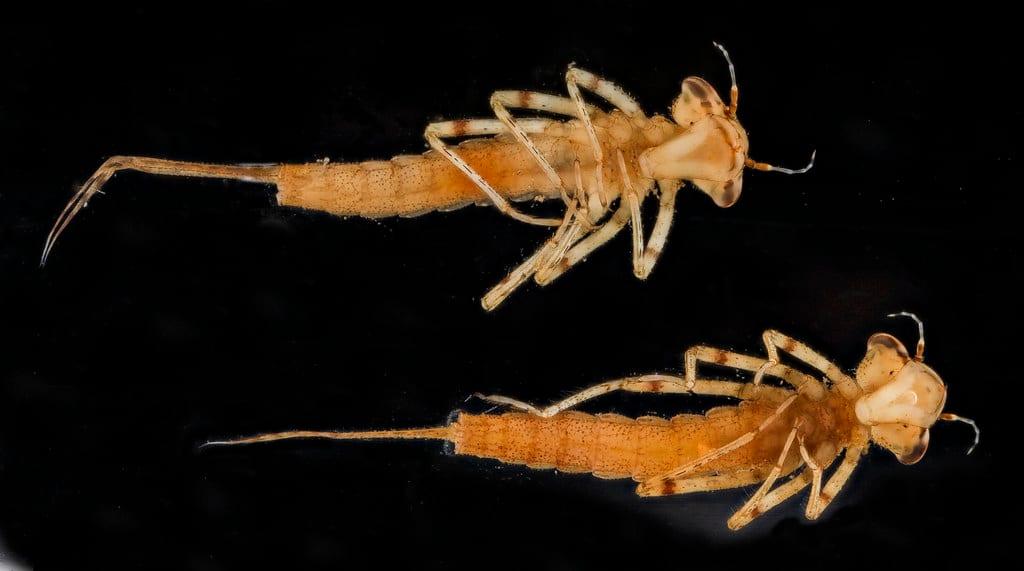
Best Nymphs
Best Nymphs for Trout
Four nymph patterns that catch trout almost anywhere, plus the nymph-only assortments worth owning.

Flies & Fly Tying
What Flies to Use for Trout
A repeatable method for choosing a fly: read the water, match size first, and know what to do when nothing shows.
Flies & Fly Tying
The Dry-Dropper Rig, Explained
How to set up a dry-dropper rig: spacing, flies, knots and the mistakes that cause tangles.
Waders & Boots
Waders by Water Temperature
A water-temperature table for waders and layers, with a separate column for standing still.