
Best Beginner Reel
Best Fly Reels for Beginners
Beginner fly reels ranked on drag sealing rather than drag power — and whether you need one at all.
Category
On a trout rod the reel is mostly line storage. Here is the part of it that genuinely matters, and the part you are being sold.
The short answer
A sealed drag at a trout-reel price, rated exactly 3-5 weight, 5.6 oz, and it converts to left- or right-hand retrieve without tools. Sealed is the feature worth paying for when you wade gravel.
Here is the thing nobody selling reels will tell you: for most trout fishing, a fly reel is a place to keep line. You strip line off it with your hand, you cast, you retrieve by pulling line in with your hand, and you wind it back onto the reel when you walk to the next pool. The reel does nothing in between.
The reel's drag — the adjustable resistance that slows a running fish — only comes into play when a fish takes enough line to pull it directly off the spool. On a 5-weight with 5X tippet, a trout strong enough to do that is also strong enough to break the tippet long before the drag setting matters. Which means the enormous drag numbers printed on reel packaging are, for a trout beginner, close to irrelevant.
What does matter, in order:

Best Beginner Reel
Beginner fly reels ranked on drag sealing rather than drag power — and whether you need one at all.
Best Under $100
What around-$100 buys in a fly reel, including a CNC-machined body, and what it gives up.
Fly Reels
What arbor size changes, why line memory matters more than retrieve speed, and when mid arbor is fine.
Fly Reels
A sealed drag at a trout-reel price, reviewed — including who should buy something simpler.

Fly Reels
Huge drag and a lifetime warranty for the money — and an honest account of why trout anglers may not need it.

Fly Reels
Reel sizes and brand labels mapped onto rod weight and backing capacity, in one table.
Fly Reels
What backing is, how much to use, and why it matters on every cast rather than only on big fish.
Fly Reels
Five decisions in order, starting with the one most buying guides skip: whether you need a reel at all.
Fly Reels
Reel size matters for fit and balance, not performance. What the number actually changes.
| Tier | What changes | Realiztic band |
|---|---|---|
| Included in a combo | Adequate; a working reel you may never replace | Bundled |
| Budget standalone | Machined or die-cast body, basic disc drag | Tens of dollars |
| Mid | Sealed drag, better tolerances, large arbor | Low hundreds |
| Premium | Fully machined, sealed, very light, cosmetics | Mid-to-high hundreds |
Reel sizes are labeled inconsistently. One brand's "size II" covers 3-5 weight; another's "5/6" covers 5 and 6; a third just prints a number. The thing they all agree on is that the reel should state a line-weight range, and your rod's weight should be inside it.
| Rod weight | Reel you want | Typical backing |
|---|---|---|
| 3-4 wt | Smallest trout size (often 'I' or '3/4') | 50-75 yd of 20 lb |
| 5 wt | 3-5 wt or 5/6 class (often 'II') | 75-100 yd of 20 lb |
| 6 wt | 5-7 wt or 5/6 class | 100 yd of 20 lb |
| 8 wt | 7-9 wt class (often 'IV') | 150-200 yd of 20-30 lb |
Our fly reel size chart is the full version of that table including how the brands' labels map onto each other, and does fly reel size matter? answers the question directly for anyone who has been told a bigger reel is always better.
A fly line is only about 85 to 90 feet long. Backing is cheap braided line — usually 20 lb Dacron — that goes on the spool first, underneath the fly line. It does two jobs: it fills the spool so your fly line sits on a larger diameter and coils less tightly, and it gives a fish somewhere to run if it takes more than 90 feet.
For trout you will almost never see your backing. Put it on anyway, because the spool-filling job is real and happens on every cast. If you bought a combo, it is already on there. How much backing for a fly reel covers the quantities and how to work out whether you have too much or too little.
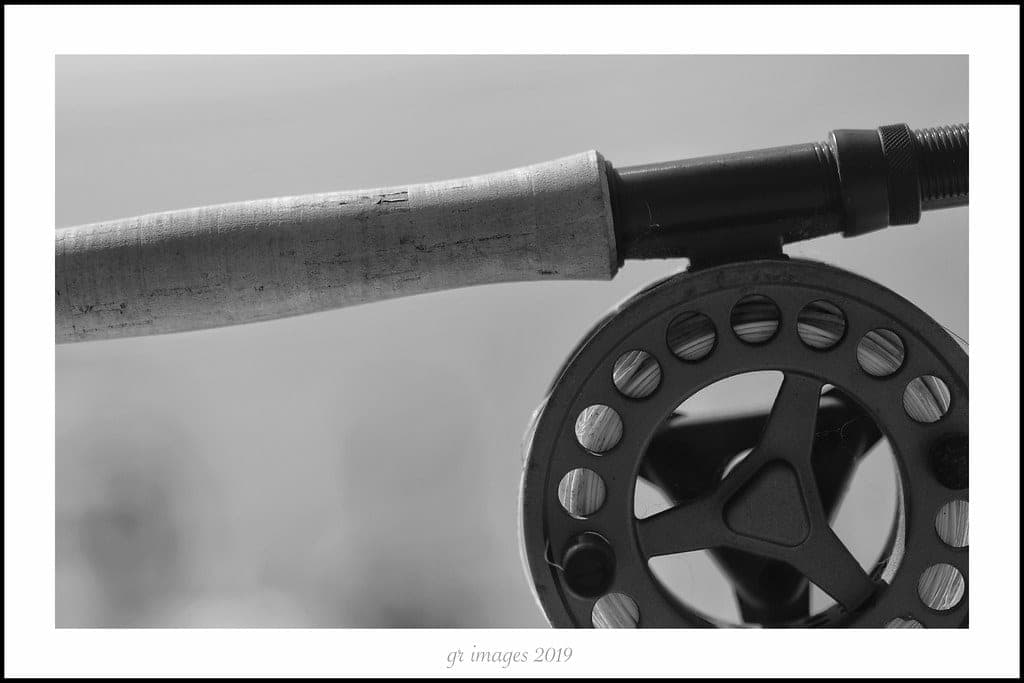
Arbor is the diameter of the spool's center. A large arbor has a wide center: you retrieve more line per turn of the handle, and the line comes off in big relaxed loops. A mid or standard arbor has a narrower center: slower retrieve, tighter coils. Tight coils are mostly a cosmetic annoyance in warm weather and a genuine nuisance in cold weather, when fly line is stiff and a coiled line tangles around your feet.
Given a choice at the same price, pick large arbor. It is not worth paying a large premium for. Large arbor versus mid arbor has the side-by-side.
We have been dismissive of drag because for trout on light tippet it deserves to be. There are three situations where that flips, and it is worth knowing whether you are in one:
If any of those is in your near future, a reel like the Redington Behemoth makes sense as a buy-once purchase. If none of them is, the money is better spent on line, leaders and flies. How to choose a fly reel walks the whole decision.
Usually no, and this is the most common upgrade mistake we see recommended. The components on a beginner combo rank for replacement in this order: line first, by a wide margin; then leaders and tippet; then the rod; then the reel. A combo reel that holds line, has a drag that turns smoothly, and has not been full of sand is doing its job.
The exception is a plastic-framed reel whose drag has become gritty or jerky, because that failure mode breaks tippet on good fish. If that is what you have, the best fly reels under $100 roundup is the right page.
Yes, but only for fit rather than performance. The reel needs to hold your fly line plus backing without overfilling, and it needs to be light enough not to unbalance the rod. Beyond that, a larger reel does not help a trout angler — it just adds weight. Match the reel's stated line-weight range to your rod's weight and stop there.
A reel rated for 3-5 weight or 5/6 weight, which most brands label as a size II. That holds a 5-weight line over roughly 75 to 100 yards of 20 lb backing without overfilling the spool. Check the reel's own stated line-weight range rather than trusting the number on the box, because brands label sizes differently.
The arbor is the diameter of the spool's center. A large arbor has a wide center, so you retrieve more line per turn and the line sits in looser coils. A mid or standard arbor is narrower: slower retrieve and tighter coils. Large arbor is the better choice at the same price, mainly because loose coils tangle less in cold weather.
Yes, and not primarily for the reason people assume. Backing gives a running fish somewhere to go past the end of your 85-to-90-foot fly line, which for trout almost never happens. Its everyday job is to fill the spool so your fly line sits on a larger diameter and coils less tightly, and that affects every single cast.
Roughly 75 to 100 yards of 20 lb Dacron on a size II reel, but the right amount is whatever fills the spool so that the fly line, fully wound, sits just below the spool rim. Too much and the fly line will not fit; too little and the line coils tightly. If you bought a combo it is already spooled correctly.
Probably not yet. On a beginner combo the components worth replacing, in order, are the fly line first by a wide margin, then leaders and tippet, then the rod, then the reel. The exception is a reel whose drag has become gritty or jerky, because an uneven drag is what actually breaks light tippet on a good fish.
Category
The six things you need, in the order you need them — and the three things everyone tells you to buy that you can skip for now.
Category
Start with a 9-foot 5-weight. This is the hub that explains why, and which one to buy.
Category
Your rod does not cast the fly — the line does, and the fly goes along for the ride. This is the most under-explained part of the sport.